
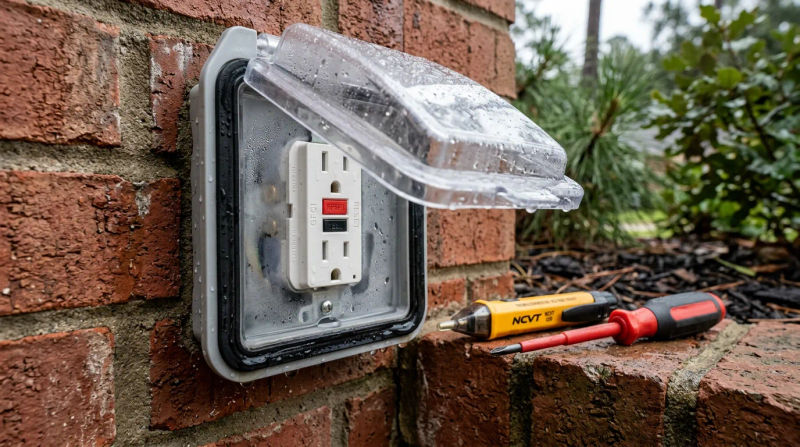
You step out onto your patio after one of those intense September downpours, ready to plug in the string lights for the evening. You flip the weatherproof cover, push in the plug, and click - the power is gone. You press the “RESET” button on the GFCI outlet, and it immediately trips again. That frustrating cycle of a GFCI outlet tripping is more than just an inconvenience; it’s a critical safety warning that your electrical system is detecting a problem, especially after it rains.
As a Senior Home Services Technician with over a decade of experience in the Houston area, I’ve seen this exact scenario play out countless times. Here in The Woodlands, our combination of heavy rain, remnants of tropical storms, and persistent Texas humidity creates a perfect storm for electrical issues in outdoor and garage outlets. A GFCI that trips after rain is doing its job by protecting you from a potential electrical shock, and understanding why it's happening is the first step toward a safe and reliable solution.
Common Signs and Symptoms
A tripping GFCI is the most obvious sign, but other symptoms can help pinpoint the issue. When our technicians arrive on-site, we look for a pattern of clues. You should too.
- Immediate Tripping After Rain: The most common sign. The outlet works fine when it's dry but trips within moments of a storm starting or shortly after it ends. This is a clear indicator that moisture is the culprit.
- Refusal to Reset: The outlet’s “RESET” button won’t stay engaged. You might hear it click, but it pops back out immediately. This indicates a persistent ground fault is present on the circuit.
- Tripping with High Humidity: Even without rain, you might find your outlet keeps resetting. Texas humidity can be so high that condensation forms inside an improperly sealed electrical box, providing just enough moisture to trigger the GFCI's sensitive internal mechanism.
- Visible Moisture or Corrosion: Take a close look at the outlet itself. Do you see condensation inside the clear plastic weatherproof cover? Are the screw heads or receptacle slots showing signs of rust or greenish-blue corrosion? These are tell-tale signs of water intrusion.
- Tripping Other Outlets: A single GFCI outlet is often installed at the beginning of a circuit to protect all the other standard outlets “downstream” from it. If your garage GFCI trips and your exterior patio outlets also lose power, the fault could be in any of those locations, not just the GFCI outlet itself.
What Causes This Problem
A Ground Fault Circuit Interrupter (GFCI) works by constantly monitoring the flow of electricity. It measures the current going out to a device and the current returning. If there’s even a tiny imbalance, it assumes the electricity is leaking - or “faulting” - to the ground, possibly through a person. It then shuts off the power in milliseconds. When rain is involved, that “leak” is almost always caused by water creating an unintended path for the current.
Here are the primary causes we find during our diagnostic calls for a GFCI trips after rain The Woodlands issue:
- Worn-Out Weatherproof Covers and Seals: This is the number one cause, especially in homes from the predominant 1990s-2000s building era in The Woodlands. These properties were built with outdoor electrical access for patios, pools, and landscape features. However, the foam gaskets and rubber seals on the “in-use” or “bubble” covers that protect these outlets have been baking in the Texas sun for 20-30 years. They become brittle, cracked, and compressed, losing their ability to keep out wind-driven rain.
- Moisture Inside the Electrical Box: Water doesn't have to get directly into the receptacle slots. It can seep behind the cover plate and into the electrical box itself. Once inside, it can create a connection between the hot wire and the grounded metal box or a ground wire, causing a fault. The complex brick and siding exteriors common on Neo-traditional homes in the area can sometimes create tricky pathways for water to travel behind the wall surface and into a poorly sealed box.
- Underground Wiring Faults: Many homes have underground wiring for landscape lighting, sprinkler system controls, or outlets near a pool or detached structure. If this underground cable has been nicked by a shovel, damaged by shifting soil, or its waterproof wire nut connections have failed, groundwater will saturate the connection after a heavy rain and cause a ground fault that trips the GFCI back at the source.
- A Failing GFCI Outlet: The device itself can go bad. The internal components are sensitive and can wear out over time, becoming overly sensitive to normal fluctuations or failing altogether. Sometimes, an older GFCI simply can't handle the load from modern outdoor equipment and will trip nuisance-style. A replacement is often the simplest fix, but only after confirming the outlet itself is the true source of the problem.
- Water in an External Fixture or Appliance: Remember, the GFCI protects the whole circuit. The problem might not be the outlet at all. A cracked landscape light fixture, a waterlogged pool pump, or an old extension cord left out in the rain can all cause a ground fault that trips a GFCI in the garage or on the porch.
When to Call a Professional
Working with electricity, especially in wet conditions, is dangerous. While a homeowner can perform some basic troubleshooting, most issues related to a tripping GFCI require professional attention for safety and accuracy.
Safe DIY Steps You Can Take:
- Unplug Everything: First, unplug all cords and devices from the affected GFCI outlet and any other outlets on the same circuit. Try resetting the GFCI. If it holds, the problem is likely one of the devices you unplugged.
- Wait and Dry: If it’s been raining, simply wait 24-48 hours for everything to dry out thoroughly. If the outlet resets and holds after that, it confirms moisture was the issue. However, this doesn't solve the underlying problem of how the water got in.
- Visual Inspection: Look at the weatherproof cover. Is the gasket cracked or missing? Is the cover itself broken? Replacing a faulty cover is a task some handy homeowners might tackle, but always be sure to turn off the power at the circuit breaker first.
When to Call for Professional Help: If the simple steps above don't work, or if you encounter any of these red flags, it's time to stop and call for help.
- The outlet will not reset, even after everything is unplugged and dry.
- You see black scorch marks, melted plastic, or smell a burnt odor around the outlet.
- The circuit breaker in your main electrical panel is also tripping along with the GFCI.
- You are not 100% confident in your ability to safely work with electrical wiring.
An experienced professional will perform systematic electrical safety checks for wet outlets. Our technicians use specialized tools like multimeters to test voltage and continuity and megohmmeters (or “meggers”) to test for tiny leaks in wiring insulation that the naked eye can't see. This organized workflow allows us to definitively locate the source of the fault - whether it's a bad receptacle, a compromised underground wire, or a leaky light fixture - and perform a correct, code-compliant repair.
Conclusion
A GFCI outlet that keeps tripping after rain is a safety system working as designed. It’s alerting you to a potentially hazardous condition. While the cause is almost always moisture intrusion, the source can range from a simple, degraded $5 gasket to a more complex issue with underground wiring.
Especially in homes built a few decades ago, proactive inspection and maintenance of exterior electrical components are key to preventing these issues. Don't be tempted to ignore a tripping GFCI or, even worse, replace it with a standard, unprotected outlet. The risk of electrical shock is far too great. Addressing the problem early ensures your home remains safe and your power remains reliable, rain or shine.
If you notice any of these signs, contact a local General Contractor professional for an inspection.